For sales reps who own a number

The game was always there. Now there's a scoreboard.

Every sales board starts at the proposal — proposals up, deals closed. Pipeway puts the rest of your work on the board: every door knocked, connection made, and appointment booked, scored. Built by a working commercial pest control rep who kept his own score in spreadsheets before building something better. Start with the free Sales Scoreboard — the exact system that changed my sales career.

YOUR SALES FUNNELEXAMPLE WEEK
Prospect attempts100
↓ 70–80% lost
Connections25
↓ 50–70% lost
Booked appointments12
↓ 30–50% lost
Proposals7
↓ 50–70% lost
Sales3

Every funnel leaks — you lose 95–98% of prospects somewhere. The question is: at which stage? Most reps can't answer. That's the whole problem.

You're not short on effort. You're short on visibility.

If you have a revenue goal, you already know the feeling. You're knocking doors, making calls, sending the follow-ups. You're logging activity in a spreadsheet — or worse, not logging it at all. You're working 50–60 hours a week. And you're still missing your number.

The problem isn't hustle. It's not even skill. The problem is you don't know:

RATE

What your connection rate is

…and whether it's actually good, or quietly killing your month.

STAGE

Where prospects drop off

…because nobody ever showed you your own funnel.

LEAK

Which stage kills your close rate

…so you fix the wrong thing, or fix nothing at all.

EDGE

What top reps do differently

…hint: they aren't working more hours than you.

The short version of a long story

I didn't learn this in a sales book. I learned it missing my goal.

Before

I spent 10 years as an actor in Los Angeles. Auditions, rejection, hustle — the constant “will this be the one?” Then I transitioned to commercial pest control sales. I was 34. I had no idea what B2B sales was.

The wall

I missed my goal 8 of my first 10 months on the job. I was working hard — I just hadn't been given the tools to succeed. No data, no visibility, no way to tell why a good month was good or a bad month was bad.

The shift

So I set a hard goal for myself and started tracking everything — every attempt, connection, appointment, proposal, and sale, in the spreadsheet that became this scoreboard. And here's the part nobody tells you: with clean data, the goal becomes perfectly clear. You can see exactly what has to happen this week to hit your number. At that point it's not a mystery anymore — it's just a matter of effort.

After

I hit my goal 7 of the next 8 months. Same job, same territory, same hours — the difference was finally knowing where the work was going.
The breakthrough wasn't working harder. It was seeing where I was leaking — and fixing that.

Read the full story →

The framework

The 5 numbers that matter most

Forget dashboards with forty widgets. If you can only track five numbers, track these — every week. One of them is your leak.

1

Attempts per day

Every door, call, and email. The raw input your whole month is built on.

Target: 20–30 doors / day
2

Connection rate

What percent of attempts actually reach the decision maker — not the gatekeeper.

Target: 20–30%
3

Appointments per week

Conversations are nice. Sit-downs and walk-throughs are where deals start.

Target: 5–10 / week
4

Proposal close rate

What percent of quotes turn into signed deals. The most expensive leak to ignore.

Target: 30–50%
5

Revenue per appointment

The average dollar value each sit-down produces. Multiply it out and you can predict your month.

Target: $500–$2,000
Real numbers, not testimonials

My first 17 months, honestly.

No testimonials yet — the app is pre-launch, and I won't invent them. What I have is my own scoreboard, before and after I started tracking. I'll let it make the argument.

Months 1–10Missed my goal 8 of my first 10 months. Working 50–60 hours a week with no data, no visibility, and no tools to tell me why.2 / 10
The shiftSet a scoring system and a daily goal for my activity — every attempt, connection, appointment, proposal, and sale, logged in this exact sheet. The goal became perfectly clear; the rest was effort.—
Months 11–18Hit my goal 7 of the next 8 months. Same job, same territory, same hours — clear numbers.7 / 8
Free — the tool this whole site exists to give you

The Sales Scoreboard

The exact tracking system I built for myself, cleaned up so you can run it. No software to install. No learning curve. A spreadsheet you can start using today — and be finding your leak within two weeks. See everything inside →

✓

Set Up

Your sales type, your weekly targets and the floor you'll accept at each step, with a typical range beside every box. Your weekly points goal works itself out.

✓

The Board

Am I winning, in five seconds: this week against your targets, your rates against your floors, and your red number — the step costing you deals.

✓

The Daily Log

One row a day, counts only, about 2 minutes. The rule: if it's not logged, it didn't happen. Your points fill in on their own.

✓

Closed Deals

Every deal with its commission. The tab Pipeway imports, so your history comes with you.

✓

Your History

Your totals kept week by week. Switch the view to month, quarter or year, with points against your goal and the revenue you closed.

Built for

  • Sales reps who work a pipeline — doors, dials, demos, or all three
  • Field and outside sales — pest control, cleaning, HVAC, landscaping, and beyond
  • Inside sales and SDRs — the stages flex from doors to dials
  • Anyone tired of guessing and ready to start knowing

Not for

  • Anyone hoping for a magic button — you still have to log the work
  • Reps who won't look at their own numbers — the sheet only works if you feed it
Where this is going

Half a second to log. A whole career on the board.

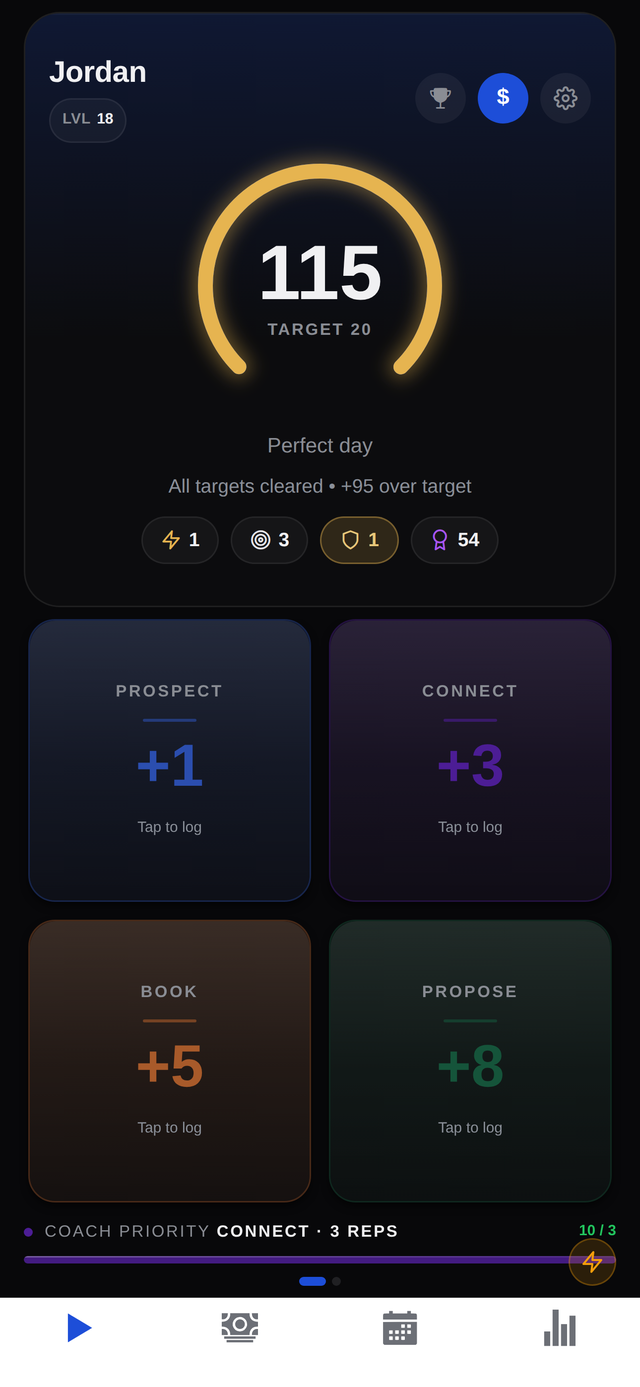
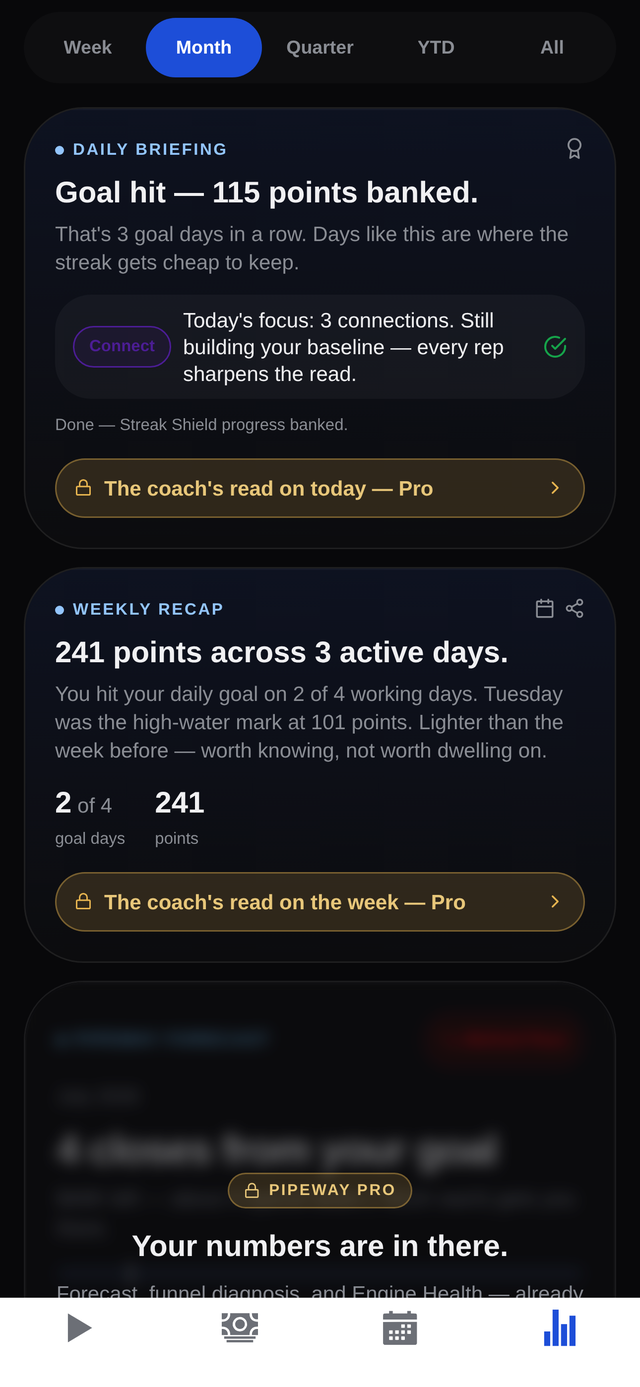
The scoreboard is the score on paper — it's how I found my leaks. So I built Pipeway to put the score in motion: a door knock logged by tap, a closed deal logged by voice, and the work is on the board — 47 points against a goal of 25, streak alive — with credit even on days nothing closes. Every morning, a coach reads your numbers and tells you the one thing to work on today. The prize is your payday.

Pipeway home screen with the daily progress ring and activity actions
The work, scoredFour actions, one ring. Two minutes a day.
Pipeway daily briefing analyzing the sales funnel
A coach who reads your numbersEvery morning: what happened, what it means, what to do.
Pipeway sales ledger with closed deals and revenue
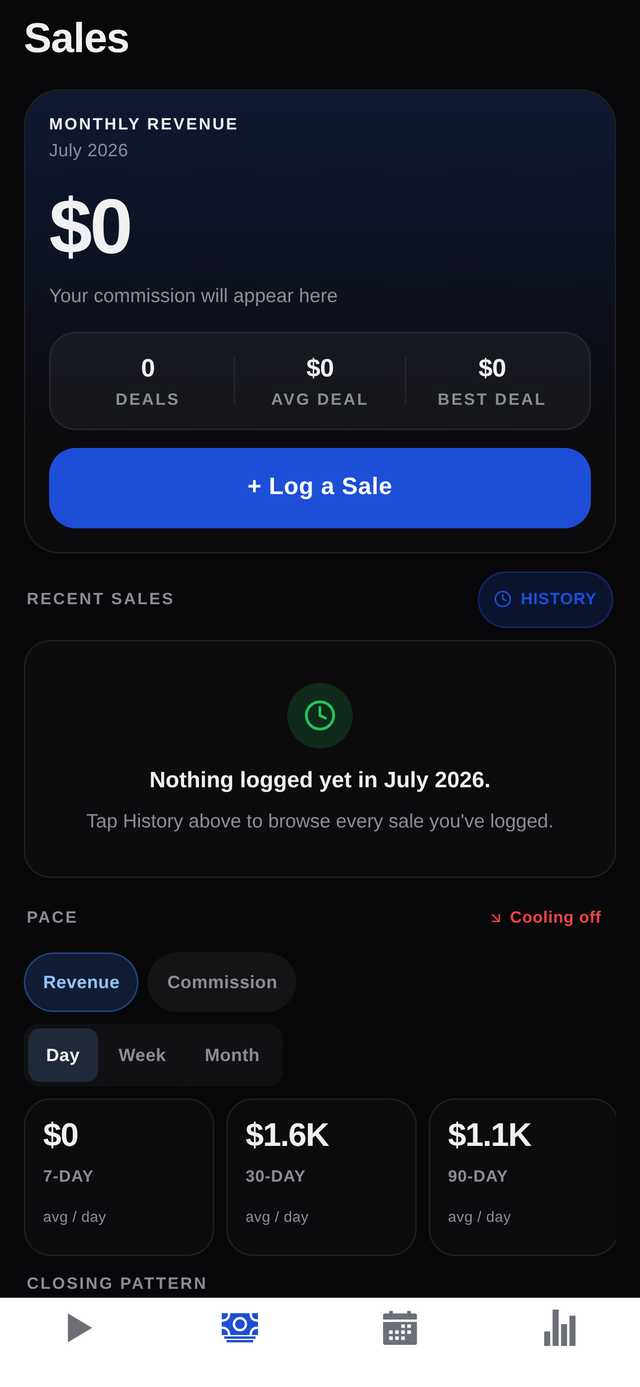
Your ledger, aliveEvery deal, every rate, every record — honest numbers only.
Coming to iOS IN TESTING

The scoreboard list hears first when it opens.

Fair questions

Is this really free?

Yes. No catch. I built the scoreboard for myself and figured other reps might need it too. You'll also get my weekly tips on reading your numbers and first word when the Pipeway app launches — unsubscribe anytime.

Do I need to install anything?

Nope. It's a spreadsheet template — open it in Google Sheets or copy it to Excel. Start logging today.

How long does it take to use?

2–3 minutes a day to log activity, 10–15 minutes on Friday to do the weekly analysis. That's the whole system.

What if I'm not in pest control — or not even in outside sales?

The scoreboard was built for B2B sales, and the stage names flex from doors to dials to demos: attempts → connections → appointments → proposals → sales. Pick your sales type on the Set Up tab — B2B or B2C, inside or outside — and a typical range shows beside every target and floor. If your motion skips a stage, leave that floor blank and it's never judged.

Will this actually help me hit my number?

Honest answer: I missed my goal 8 of my first 10 months. After I set a scoring system and a daily goal for my activity, I hit 7 of the next 8. Your results depend on your effort and your market — but you will see where you're leaking, and that's the part nobody else shows you.

What's Pipeway, then?

The scoreboard is the score on paper. Pipeway is the same system as an app — selling, scored: every door knocked, connection made, and appointment booked goes on the board in half a second, with streaks that survive real life, levels and records earned by doing the job, and a coach that reads your numbers every morning. It's in final testing now; the scoreboard list hears first when it opens.

One more time, plainly

Stop guessing. Start knowing. Get the scoreboard — free.

Two minutes a day. Ten minutes on Friday. In two weeks you'll know exactly which stage is costing you deals — probably for the first time in your career.